

Field Notes (Weekly Observation)
Pre-Construction 24/7 – Arshad Syed
Dubai skyline as a stable anchor!
Geopolitical tension rarely announces itself in clean economic terms.
It appears first as headlines, then as volatility, and only later as structural change. The recent strain between Saudi Arabia and the UAE over Yemen is a reminder of how quickly uncertainty can surface — and how unevenly markets respond to it.
In moments like this, the question is not whether markets react. They always do.
The more useful question is where capital goes when confidence is disrupted elsewhere.
This observation is not unique to the Middle East. It has repeated across conflicts, policy shifts, and global disruptions over the last decade. What changes is the location; the behavior remains consistent.
1. Short-Term Markets React to Headlines
When geopolitical tension rises, financial markets tend to respond first.
Dubai’s equity index recently pulled back, with major banking and real estate names declining alongside broader Gulf markets. This kind of movement reflects sentiment rather than structural damage. Risk premiums rise, traders reduce exposure, and liquidity temporarily seeks safety.
This pattern is familiar.
Stocks are designed to react quickly because they are liquid, priced continuously, and sensitive to uncertainty. That responsiveness is not a signal of collapse — it is a feature of the system.
What matters is what happens after the initial reaction.
2. Geopolitical Risk Is Not the Same as Economic Breakdown
Tensions between regional partners introduce uncertainty, but uncertainty does not automatically translate into economic failure.
The Saudi–UAE divergence in Yemen reflects strategic differences, not a breakdown of domestic governance or institutional function within the UAE. Markets often struggle to separate these layers, especially in the short term.
Uncertainty raises caution.
Caution slows decision-making.
But it does not erase capital.
Historically, periods of geopolitical stress tend to redistribute money rather than destroy it. Capital looks for jurisdictions where contracts remain enforceable, ownership rules are clear, and policy frameworks are unlikely to change abruptly in response to external pressure.
This distinction is critical. Investors are not searching for regions without conflict. They are searching for systems that continue to function despite it.
3. Real Estate Responds to Structure, Not Speed
Unlike equities, real estate does not trade on headlines.
Property markets respond slowly because they are shaped by migration, residency decisions, business relocation, and long-term capital commitment. These forces move on a different timeline than financial markets.
Dubai has historically benefited from this lag.
During periods of regional or global tension — including conflicts in Eastern Europe, shifts in Western policy, and instability elsewhere in the Middle East — Dubai has often functioned as a receiver of displaced confidence rather than a speculative hotspot.
This does not mean prices rise instantly or uniformly.
It means demand is supported by capital looking for continuity.
“Property markets don’t trade fear hourly. They price trust slowly.”
4. Neutrality as an Economic Function
Dubai’s role is often misunderstood as momentum-driven. In reality, its strength has been its ability to remain operationally neutral while maintaining regulatory clarity.
Neutral hubs serve a specific function in global capital flows:
- They absorb volatility generated elsewhere
- They provide legal and financial continuity
- They allow capital to wait without exiting the system entirely
This is why Dubai appears repeatedly during periods of disruption — not because it promises certainty of returns, but because it offers certainty of rules.
5. Energy Politics and Economic Diversification
Regional tension inevitably raises questions about oil markets and OPEC+ coordination. Energy volatility can influence sentiment across the Gulf, even in economies that are less oil-dependent.
Dubai’s diversification matters here.
Its economy is weighted toward finance, logistics, tourism, and global trade rather than direct hydrocarbon revenue. This does not make it immune to regional shocks, but it does dilute transmission risk.
Oil price stability reduces spillover effects.
Economic diversification reduces dependency.
Together, they soften the impact of geopolitical noise.
What This Observation Suggests
In the short term, headlines drive volatility.
In the long term, capital follows systems.
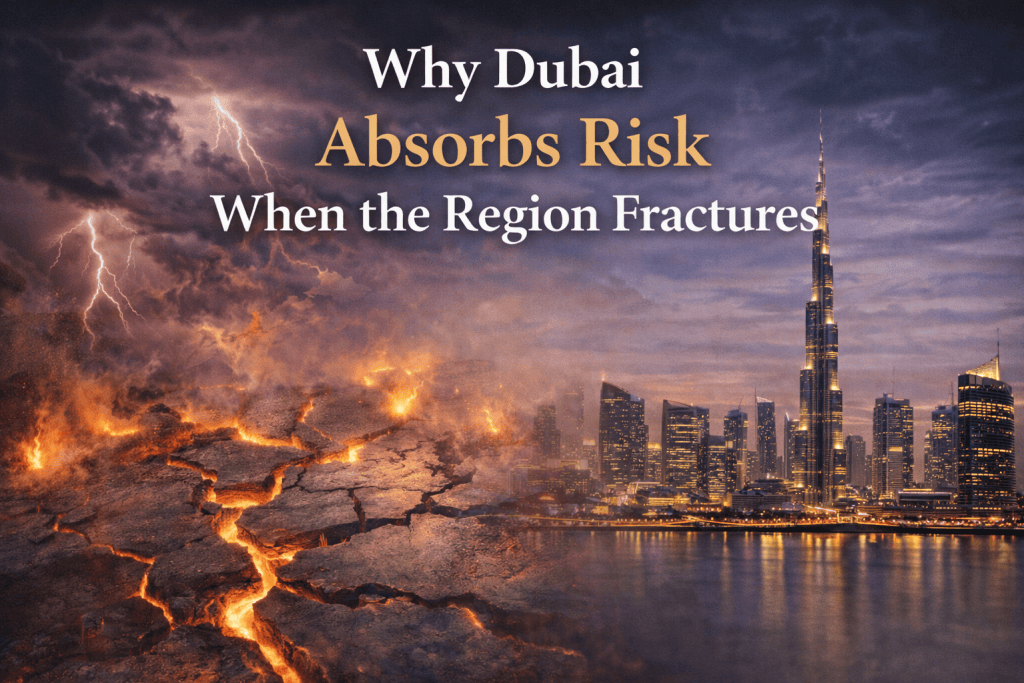
Dubai’s resilience is not about avoiding risk. It is about absorbing it from elsewhere. That distinction explains why equity markets may wobble while real estate demand remains structurally supported.
This is not a forecast.
It is a pattern.
Understanding that pattern helps separate signal from noise — and prevents short-term reactions from being mistaken for long-term shifts.
Closing Note
Capital does not move toward places without tension.
It moves toward places where rules survive tension.
That difference explains more about global real estate flows than any single headline ever will.
This observation connects to earlier Field Notes on capital behavior, timing, and structural risk.
Why Global Capital Keeps Circling Dubai?
On Deposits and Early Commitment!
When Household Balance Sheets Start to Fray!
Do your own due diligence—this market rewards the informed and punishes anyone who blindly trusts the hype!
Editorial Note
All content published on Pre-Construction 24/7 reflects market commentary and system-level analysis informed by publicly available data, industry reporting, and observed real estate trends. Content is provided for educational and informational purposes only and does not constitute legal, financial, or investment advice. Individual outcomes vary based on contract terms, lender policies, market conditions, and personal circumstances.