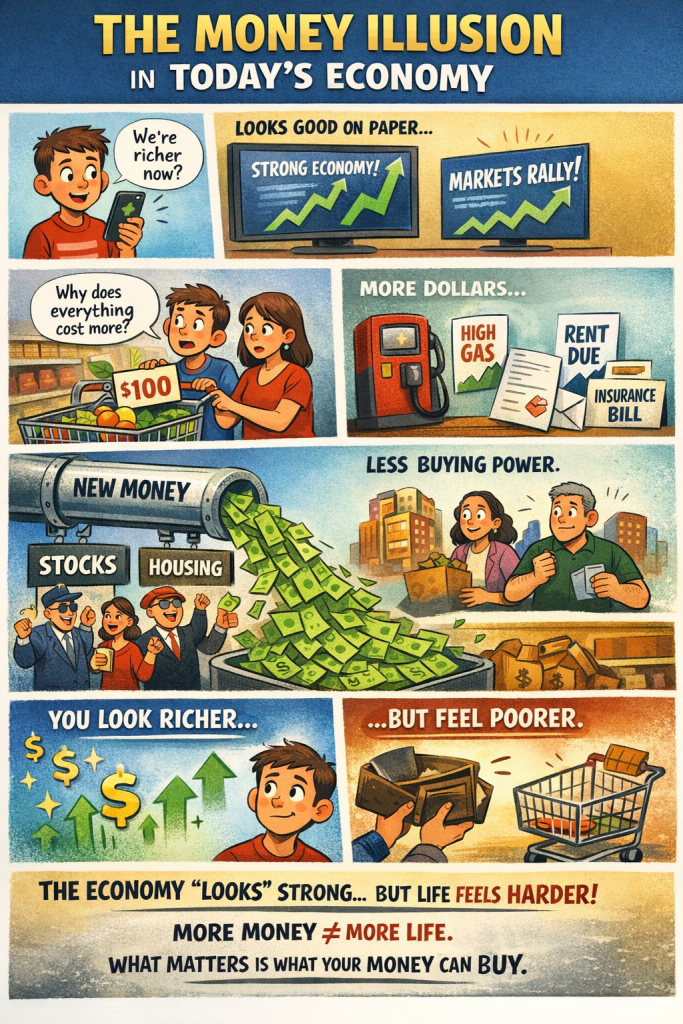
The Town Where Numbers Grew but Life Got Harder
Once upon a time, there was a town called Dollarville.
Every year, the kids in Dollarville checked their scoreboards. These scoreboards showed how many points their families had. One year, the numbers went up a lot.
“Wow!” people said.
“My house score is higher.”
“My savings score is bigger.”
“We must be doing great!”
Everyone felt proud and safe because bigger numbers felt like winning.
But then something strange started happening.
When families went to the grocery store, the same food cost more points than before.
Gas for the car cost more.
Electricity, insurance, school supplies — all more expensive.
One kid asked their parents,
“If our numbers are bigger, why do we have to buy less?”
That’s when the town learned about the Money Illusion.
What the Money Illusion Is
The illusion is when:
- Your numbers go up
- But what those numbers can buy goes down
So you feel richer, but you’re actually poorer in real life. It’s like getting more game coins, but the store secretly raises all the prices.
Who Changed the Prices?
In Dollarville, there was a big machine called The Money Maker.
When the town leaders turned it on, it created new money. But the money didn’t go everywhere equally.
First, it went to:
- Big stock players
- Big house owners
So stocks jumped higher. Houses became more expensive. People who already owned these things saw their scoreboards explode with points.
What About Everyone Else?
Most people didn’t get more pay right away.
But prices still went up.
So:
- Rent went up
- Food went up
- Bills went up
Their scoreboard showed a bigger number, but their shopping cart got smaller.
The Trick
From far away, Dollarville looked rich:
- Rising numbers
- Shiny charts
- Happy headlines
But up close, many families felt squeezed. The system made things look prosperous, even when life was harder.
The Lesson
Bigger numbers don’t always mean a better life.
What matters is what your money can actually buy.
That’s the Money Illusion: Looking richer on paper, but poorer in reality.
 Pre-Construction 24 7