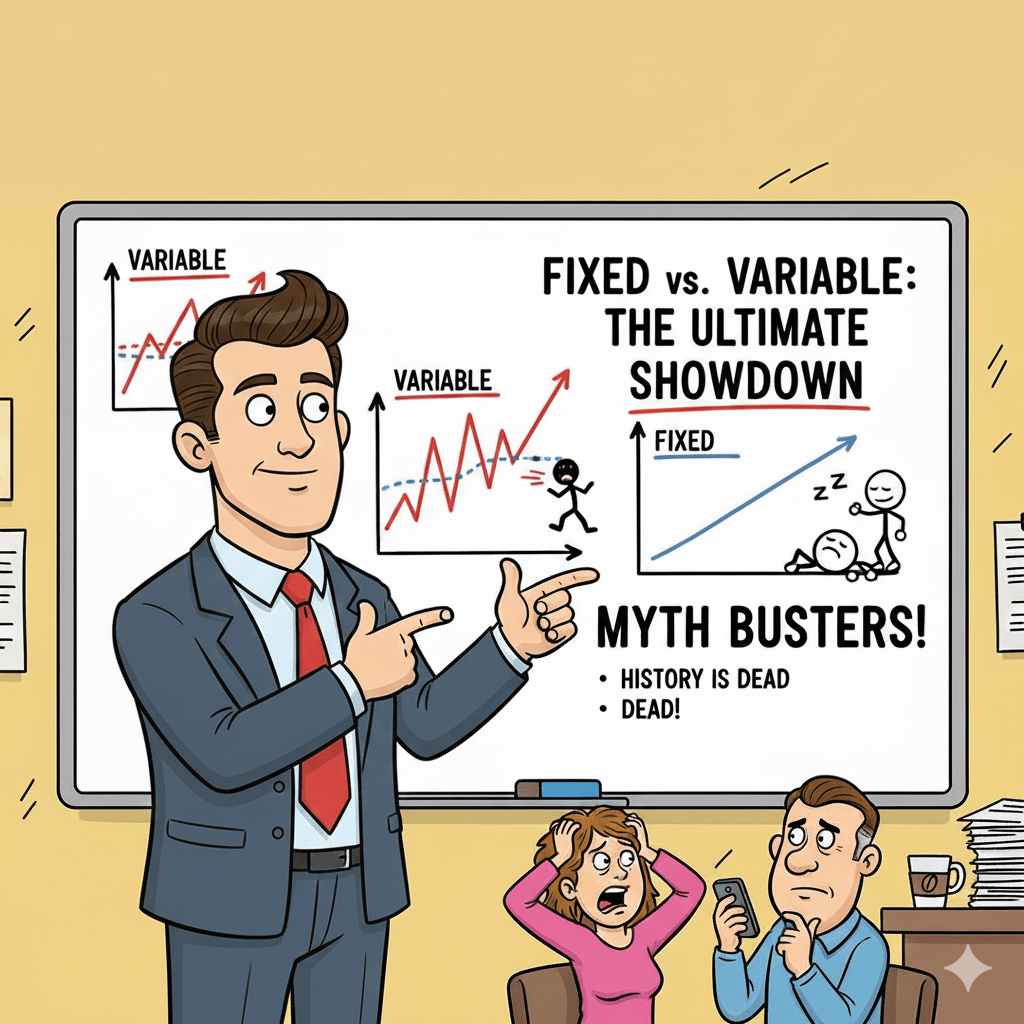
Fixed vs. Variable Mortgages: The Real Decision Homeowners Face in 2026
If there’s one question that keeps homeowners awake at night—right alongside “Did I lock the front door?”—it’s this:
Should I choose a fixed or a variable mortgage?
Everyone wants a single, universal answer. The truth is, there isn’t one.
Your income stability, risk tolerance, life plans, and stress threshold form a financial DNA that no headline or mortgage calculator can fully capture. What can be avoided, however, are decisions driven by outdated myths, bad assumptions, and coffee-shop advice that no longer applies in today’s market. As we head into 2026, here’s what actually matters.
1. The “I’ll Just Lock In Later” Illusion
This is the most common—and most expensive—mistake borrowers make.
Many people choose a variable rate believing they can simply convert to fixed if rates rise. Technically, that’s true. Practically, it’s misleading.
When you convert from variable to fixed, you don’t lock in your current rate.
You lock into whatever fixed rate the lender is offering at that moment.
So if you’re sitting at a 3.35% variable and bond yields jump, the bank might offer you 5.09% for a fixed term. The attractive fixed rate you thought you could grab is usually gone by the time fear kicks in.
The Conversion Reality
- Switching lenders often triggers a three-month interest penalty
- Staying with your lender limits negotiation power
- Banks know conversions happen under pressure—and they price accordingly
In short, by the time most people decide to lock in, the best opportunity has already passed.
2. Does “Variable Always Wins” Still Hold?
For over a decade (2009–2021), variable mortgages consistently outperformed fixed. Then came 2022.
Borrowers passed on fixed rates as low as 1.69%, chasing 1.09% variable, only to watch those rates climb above 6% in record time. That era is over.
We are no longer in a zero-rate world. Today’s environment is defined by volatility, geopolitical risk, and unpredictable inflation cycles. Relying on the last ten years of data to forecast the next five is no longer a safe strategy.
Fixed vs. Variable: A Practical Comparison
| Feature | Fixed Rate | Variable Rate |
| Payment Stability | Locked for full term | Can fluctuate or extend amortization |
| Risk Level | Lower (rate protection) | Higher (market dependent) |
| Penalty to Break | Often high (IRD) | Usually 3 months’ interest |
| Current Range (Late 2025) | ~3.89%–3.99% | ~3.35%–3.75% |
3. Ignore Confident Forecasts (Even From Experts)
You’ll hear economists—and even bank economists—confidently predicting where rates must go next.
They don’t know.
Inflation is easing, but food and energy costs remain stubborn. Central banks could cut rates twice next year—or not at all. Anyone claiming certainty about the 5-year fixed rate 12 months from now is guessing.
Confidence does not equal accuracy.
4. A Simple, Real-World Rule of Thumb
If I were signing a mortgage today or reviewing a renewal notice, here’s the gut-check rule I’d follow:
If you can secure a 5-year fixed rate below 4%, take it.
Yes, variable rates might fall another 0.50%. But the psychological and financial stability of locking in a sub-4% rate is meaningful—especially for households juggling rising costs elsewhere.
Roughly 40%+ of borrowers are still choosing variable, betting on further cuts. That’s a large collective gamble.
The issue?
Most people don’t track bond yields daily. By the time the average borrower feels it’s “time to lock in,” the market has already moved.
The Bottom Line
Choose a Variable Rate if:
- You have high risk tolerance
- You can absorb payment shocks
- You plan to sell or break the mortgage early
Choose a Fixed Rate if:
- Stability matters more than marginal savings
- You want predictable payments
- You can lock in a rate starting with “3”
There’s no perfect answer—only a decision aligned with your reality. In uncertain times, clarity and discipline matter more than chasing the last decimal point.
 Pre-Construction 24 7