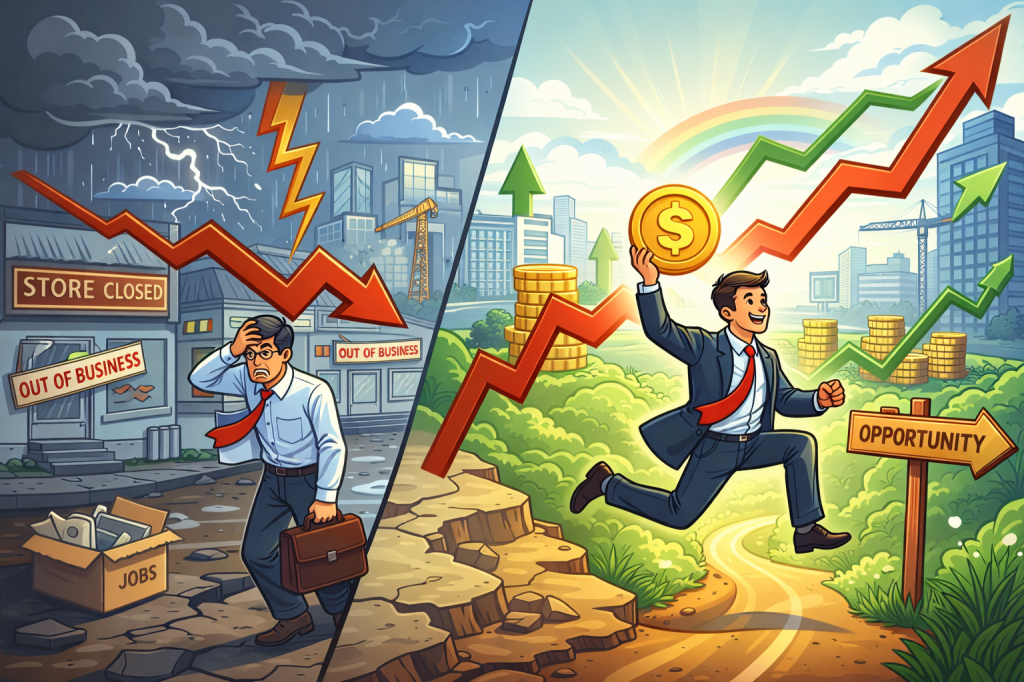
How Recessions Really End. And Why the Worst Moments Often Come Right Before the Best Opportunities. Recessions are scary. There is no polite way to say it.
When a recession hits, unemployment can jump into double digits. Businesses fail by the thousands. People who worked hard their entire lives can lose jobs, savings, homes, and confidence in a very short period of time. You see panic in the streets, stress in households, and fear everywhere you look.
The news gets darker every day. Experts argue nonstop. Headlines talk about collapse, crisis, and uncertainty. In the middle of all this, it feels like the economy is broken forever.
But history tells us something very important — something most people forget when fear is at its highest:
Every recession has ended. Every single one.
Not most. Not some.
All of them.
The Great Depression ended.
The oil crisis of the 1970s ended.
The brutal early-1980s recession ended.
The dot-com crash ended.
The 2008 financial crisis ended.
The COVID recession ended.
The pain feels permanent while you’re inside it, but it never is.
What most people also don’t realize is that recessions do not end randomly. They follow patterns. Certain things happen again and again near the bottom. There are signals that appear before recovery begins — signals that are visible if you know what to look for.
Understanding those signals can completely change how you experience recessions — financially and emotionally.
Why Recessions Feel Hopeless While They’re Happening
At the start of a recession, people usually underestimate it.
They think it will be short.
They expect governments or central banks to fix it quickly.
They assume their job is safe.
This stage is called denial.
As time passes, denial turns into worry. Layoffs rise. Spending slows. Businesses pause expansion. Fear replaces optimism.
Then comes the most dangerous stage: despair.
This is when people stop asking when things will improve and start asking if they ever will. They lose faith in recovery itself.
Ironically, this emotional low point usually happens near the bottom, not at the beginning.
Extreme Pessimism Is a Bottom Signal
One of the most consistent patterns in economic history is this:
Pessimism peaks at the bottom.
By the time fear is universal:
- Investors who were going to sell have already sold
- Businesses that were going to fail have already failed
- Consumers who were going to panic have already panicked
There is no one left to push prices much lower.
You see this extreme pessimism everywhere:
- Consumer confidence collapses
- Investor sentiment turns overwhelmingly negative
- Media predicts permanent decline
- Cash feels “safe” and investing feels reckless
This feels bearish — but historically, it’s bullish.
As legendary investor John Templeton said:
“Bull markets are born on pessimism.”
Central Banks Eventually Respond Aggressively
Modern economies are heavily influenced by central banks.
During recessions, central banks eventually step in with force:
- They cut interest rates
- They inject liquidity
- They support banks and credit markets
- They signal they will do “whatever it takes”
They are not always fast. Sometimes they underestimate the damage. But they always respond.
This response doesn’t end a recession overnight. There’s a delay. But it lays the foundation for recovery by restoring confidence and making money easier to access.
When central banks shift from hesitation to aggression, it’s a powerful sign that the worst phase is nearing its end.
Inventories Get Depleted Too Far
This signal is less emotional but extremely important.
During recessions, businesses stop ordering new inventory. They sell what they have and avoid restocking. This worsens the downturn because suppliers and factories lose orders.
But inventories cannot fall forever.
Eventually:
- Retail shelves go empty
- Car lots run dry
- Manufacturers lack raw materials
At some point, businesses must restock just to function. When that happens:
- Orders resume
- Production ramps up
- Workers are rehired
This inventory rebuild has helped end many recessions, including 2009.
Credit Conditions Begin to Ease
Recessions tighten credit.
Banks become fearful. Lending standards rise. Loans are denied. Borrowing becomes expensive. This chokes the economy.
But credit markets don’t stay frozen forever.
As stability returns:
- Banks rebuild capital
- Risk appetite improves
- Lending standards loosen
- Competition for borrowers returns
One key indicator is credit spreads — the gap between safe government bonds and riskier corporate bonds. When this gap narrows, it means fear is fading.
Credit is the lifeblood of the economy. When it flows again, recovery follows.
Leading Indicators Turn Before the Economy Does
Most people watch the wrong data.
GDP and unemployment are backward-looking. They tell you what already happened.
Leading indicators look forward:
- Building permits
- New manufacturing orders
- Weekly jobless claims
- Stock prices
These indicators often improve while the economy still looks terrible on the surface. That’s why recoveries feel invisible at first.
By the time official data improves, the opportunity has often passed.
Markets Bottom Before the Economy Does
The stock market is not the economy — it’s expectations about the future.
That’s why markets usually bottom months before recessions officially end.
Investors begin buying when they believe the worst is behind them, not when things feel good.
Waiting for “everything to be clear” usually means missing the biggest gains.
Bad News Stops Getting Worse
The economy doesn’t need good news to recover.
It just needs news that is less bad than expected.
Examples:
- Job losses slow
- Earnings disappoint less
- Prices fall at a slower rate
Markets respond to changes in direction, not absolute conditions. When expectations are extremely low, even small improvements matter.
How These Signals Come Together
Recessions end through a process, not a single moment:
- Pessimism peaks
- Policy response intensifies
- Inventories deplete
- Credit eases
- Leading indicators turn
- Markets bottom
- Bad news stops worsening
These signals overlap and reinforce each other. When several appear together, recovery is usually closer than it feels.
What Successful People Do During Recessions
They don’t wait for certainty.
They:
- Keep some cash available
- Focus on quality assets
- Ignore daily noise
- Act gradually
- Think long-term
They accept discomfort because opportunity never feels comfortable.
What Not to Do
- Panic sell at the bottom
- Wait for headlines to turn positive
- Believe claims of permanent decline
- Rely only on backward-looking data
Every recession produces voices saying “this time is different.” History shows they are always wrong.
Why Recoveries Last Longer Than Recessions
Recessions are short. Expansions are long.
On average:
- Recessions last under a year
- Expansions last several years
Patient participants benefit far more from recoveries than they lose during downturns.
The Psychological Battle Is the Hardest Part
Fear feels logical during recessions, but it’s often misleading.
Those who manage emotions, study history, and stick to a plan gain an enormous advantage.
Recessions don’t end when fear disappears.
Fear disappears after recessions end.
Final Thought
Recessions are painful, but they are not permanent.
They follow patterns. They leave signals. They end.
Those who understand how recessions end stop fearing them — and start preparing for what comes next.
The greatest opportunities are born when confidence is lowest.
That has always been true. And it always will be.
 Pre-Construction 24 7