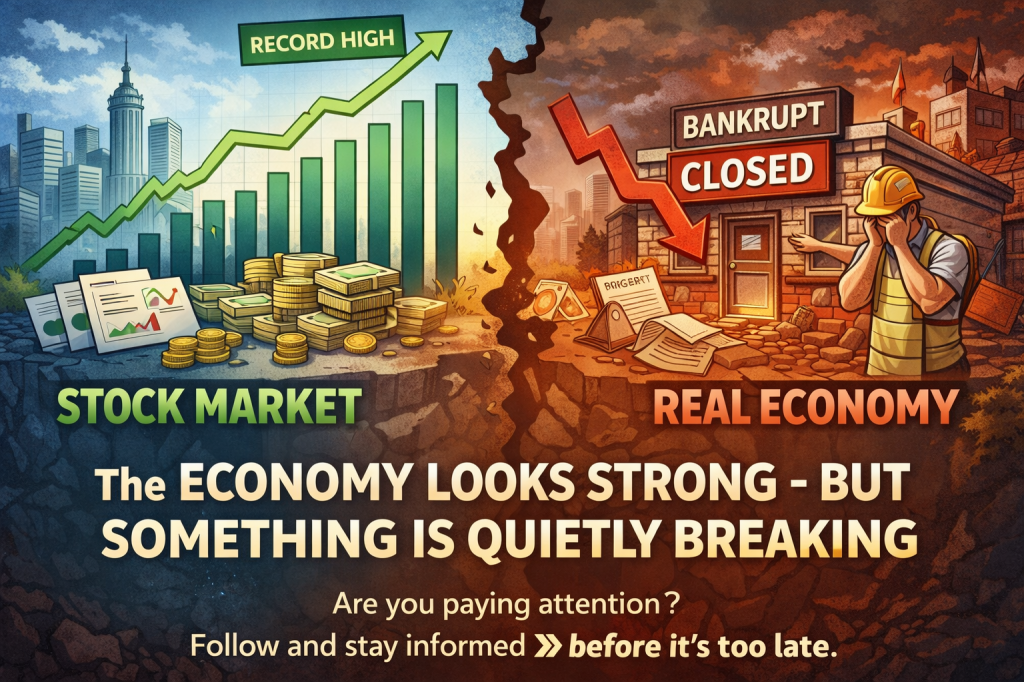
Markets are at record highs, politicians talk about a “soft landing,” and headlines suggest everything is under control. But beneath the surface, the real economy is quietly cracking. The businesses that build homes, move goods, and serve communities are failing at rates worse than 2008—while most people aren’t paying attention. This isn’t a market cycle. It’s a warning.
While the stock market keeps hitting record highs and politicians celebrate a so-called “soft landing,” the real economy—the one most people actually live in—is quietly falling apart.
This isn’t about tech stocks, market charts, or headlines flashing green. It’s about small businesses, construction companies, trucking firms, and restaurants shutting down at alarming rates. These are the businesses that build homes, move food, repair buildings, and employ everyday Canadians. When they disappear, the economy doesn’t just slow down—it loses real capacity that is hard to replace.
According to official Canadian government data, business failures in 2025 are worse than during the 2008 financial crisis. Not close. Worse. And these aren’t risky startups or speculative crypto projects. These are essential, real-world businesses. When they fail, communities weaken and supply chains break.
A Two-Tier Economy Has Emerged
What we are seeing now is a split economy.
At the top are large corporations and banks. They can borrow money cheaply, access capital markets, and survive—even thrive—during chaos. Their stock prices rise, executives get richer, and headlines stay optimistic.
At the bottom is Main Street, the physical economy. These businesses rely on customers, loans, and predictable costs. They don’t have access to cheap capital. They feel every interest rate hike, every cost increase, and every drop in consumer spending. And they are being crushed.
Why This Is Happening
During the pandemic, governments stepped in with emergency loans and cheap money to keep businesses alive. For a while, it worked. But many businesses survived only because of that support, not because they were financially strong. These became “zombie businesses”—operating, but fragile.
Then two things happened at the same time:
- Government support ended
- Interest rates rose sharply
Loans that once cost 2–3% now cost 6–8%. For households, that’s like a mortgage payment suddenly doubling. For businesses with thin profit margins, it’s often fatal—especially when wages, rent, fuel, and materials are all more expensive, while customers are spending less.
Many businesses can’t even afford the cost of bankruptcy, so they simply shut their doors and disappear. This means the real damage is likely much worse than the official numbers show.
The Hidden Risk: Psychology
The biggest danger right now isn’t just financial—it’s psychological.
Humans naturally assume tomorrow will look like yesterday. This is called normalcy bias, and it keeps people calm when they should be adjusting. At the same time, the money illusion makes people feel wealthier on paper while their real buying power keeps shrinking.
Asset prices rise, but everyday life becomes harder.
The Key Takeaway
This isn’t a normal slowdown or a temporary correction. It’s a structural break. The system built on cheap debt and endlessly rising asset prices is failing.
The most important question today isn’t how to get richer.
It’s how not to get poorer.
Understanding the difference between real value and paper promises is no longer optional. It’s essential.
 Pre-Construction 24 7