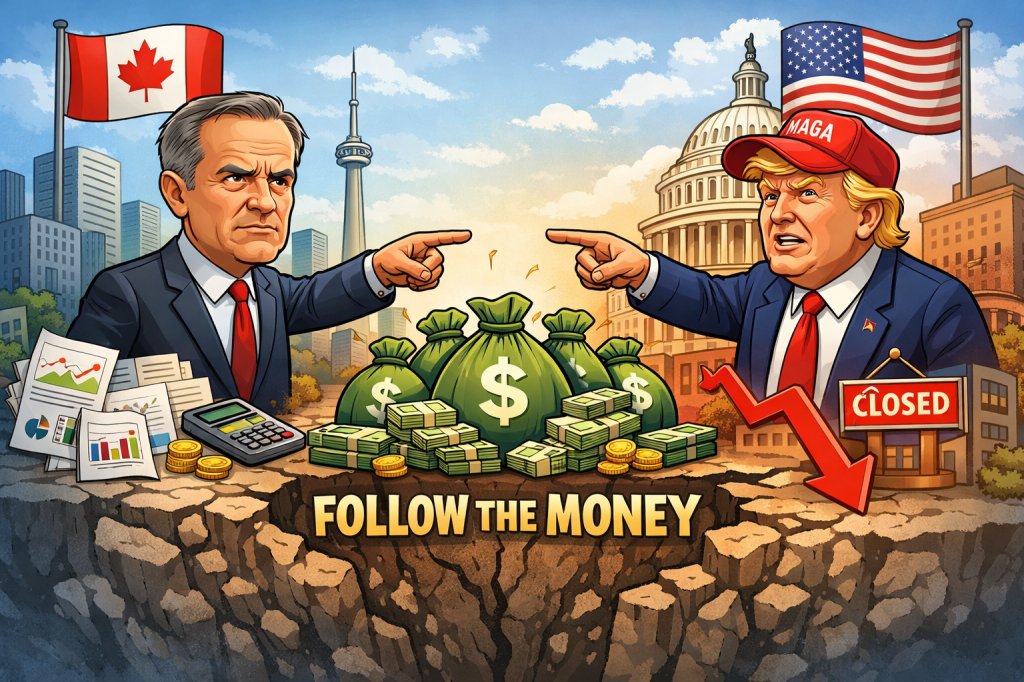
The media wants you to believe this is a political feud. In reality, it’s something far more dangerous: a silent shift of money that could reshape the economy overnight.
What is really going on?
Mark Carney versus Donald Trump, or Canada versus the U.S. But the real issue is money, not personalities.
Behind the scenes, something more serious is happening: big banks and investors may be pulling their money out of the U.S. This is called a capital withdrawal or capital strike. It doesn’t involve soldiers or laws—it just involves not lending money anymore.
And when money stops flowing, the economy slows down fast.
Why money flow matters?
Think of the economy like a car engine.
- Gas = workers, businesses, houses, factories
- Oil = loans and credit
The oil doesn’t make the car move, but without it, the engine breaks.
Banks provide that “oil” by lending money:
- Businesses borrow to pay workers
- Builders borrow to build homes
- People borrow to buy houses and cars
If banks stop lending, the engine seizes up.
Why Canada matters?
After the 2008 financial crash, many U.S. banks were weak. Canadian banks were stronger, so they quietly stepped in:
- They bought U.S. regional banks
- They funded malls, offices, apartments
- They helped finance American businesses
So today, Canadian banks are deeply tied into everyday American life, even if people don’t realize it.
If those banks decide, “The U.S. is too risky right now,” and pull back:
- Loans don’t get renewed
- Mortgages get harder to get
- Businesses struggle to survive
Why they might pull back?
Banks care about risk vs reward.
If politics look chaotic, debt is too high, and the future feels unstable, banks protect themselves. They don’t care about flags or loyalty—they care about not losing money.
So instead of lending more, they:
- Tighten rules
- Say “no” more often
- Move money elsewhere
This is a vote of no confidence, but with billions of dollars.
How this hits regular people?
This doesn’t stay on Wall Street.
It reaches:
- Small businesses that can’t get loans
- Renters whose landlords raise rents
- Homebuyers who can’t get mortgages
- Construction workers who lose jobs
The pain starts at the top but hits the bottom hardest.
The U.S. likes to say it is independent and powerful. But an economy built on debt depends on lenders. If you don’t control your own credit, you don’t fully control your future.
This isn’t about heroes or villains. It’s about a system where money moves freely, but people pay the price when it leaves.
 Pre-Construction 24 7