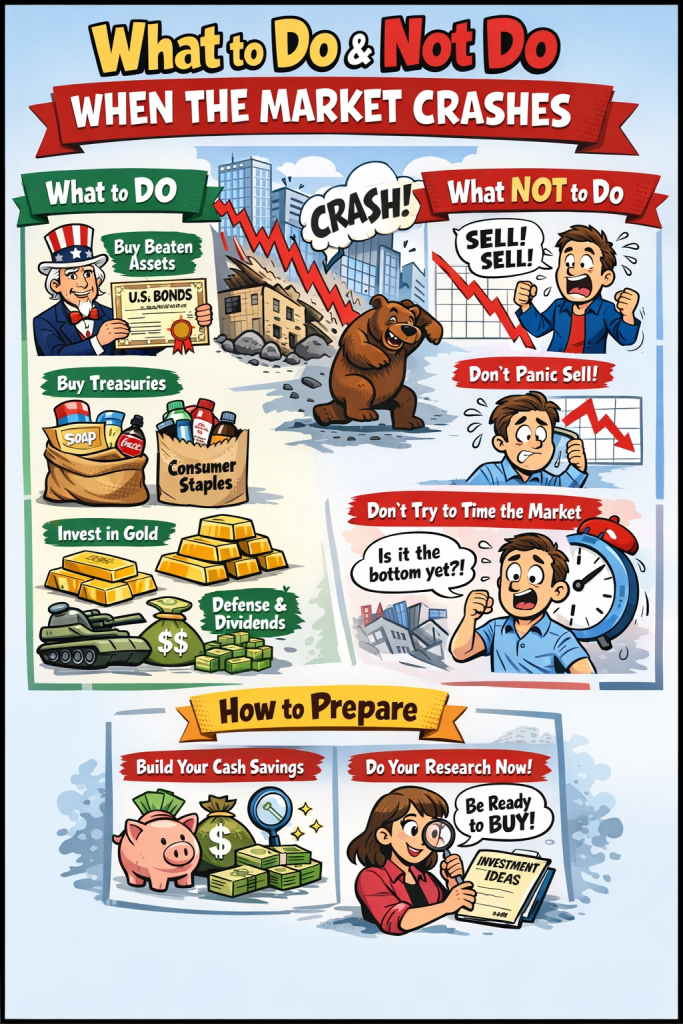
Market downturns, recessions, and stock market crashes are not rare events—they are a normal part of economic cycles. History shows that markets rise, fall, recover, and then repeat the process again. What changes every time is who is prepared and who is not.
When the next major downturn happens, there will be two broad groups of people:
- Those who lose money because they react emotionally
- Those who build wealth because they prepared in advance
Every recession creates fear—but it also creates opportunity. The difference lies in behavior, not prediction.
This article explains:
- What people should consider doing during a downturn
- What people should not do
- How to prepare before the downturn arrives
Clarification: This is general financial education, not investment advice. All investing involves risk, and individuals should always do their own research.
First, Understand This: Downturns Are Inevitable
Markets do not move in a straight line.
Over the past few decades:
- Markets have experienced multiple drops of 20%–50% or more
- Every major crash was followed by a recovery
- Each downturn created new wealth for those who acted rationally
The goal is not to predict when the next crash will happen.
The goal is to know how to respond when it does.
What You Should Consider Doing When Markets Go Down
1. Look for “Beaten” but Strong Assets
When markets fall, not all assets fall equally. Some are hit much harder than others—even if their long-term value remains intact.
This creates opportunities to buy quality assets at discounted prices.
Many experienced investors prefer broad exposure rather than betting on a single company, because:
- Individual companies can fail
- Broad funds spread risk across many businesses
The key idea is buying quality at a discount, not buying blindly.
2. Understand Defensive Assets (Not Growth Assets)
During downturns, investors often rotate away from high-growth, high-risk areas and toward assets that are seen as more stable.
Examples include:
- Government-backed instruments
- Essential consumer goods
- Assets perceived as stores of value
These assets may not generate huge returns, but they often lose less value during market stress, which helps stabilize portfolios.
3. Recognize the Role of Consumer Staples
People may stop buying new homes, cars, or luxury items during recessions—but they still buy:
- Food
- Soap
- Toothpaste
- Basic household products
Businesses tied to everyday necessities tend to be less volatile during downturns, which is why investors often pay attention to them when markets are falling.
4. Understand Why Gold Often Attracts Attention
Gold is not necessarily attractive because it produces income or rapid growth. Instead, it is often viewed as:
- A hedge against currency weakness
- A perceived store of value during uncertainty
Historically, during periods of market stress, investors often move toward assets they believe will preserve purchasing power.
5. Understand the Appeal of Dividends and Defensive Sectors
Some investors focus on:
- Companies that consistently pay dividends
- Sectors that continue receiving funding even during downturns
Dividend-paying businesses can offer:
- Ongoing cash flow
- Potential upside when markets recover
This strategy focuses on income plus recovery, rather than short-term price movement.
What You Should Not Do When Markets Go Down
1. Do Not Panic
Panic is one of the most expensive mistakes investors make.
When markets fall:
- Headlines become extreme
- Fear-based media increases
- Emotional decisions multiply
Important reminders:
- Markets are rarely as good as headlines say during booms
- Markets are rarely as bad as headlines say during crashes
Selling quality assets out of fear often locks in losses and removes the chance to benefit from recovery.
2. Do Not Try to Perfectly Time the Market
Trying to buy the exact bottom or sell the exact top almost always fails.
Why?
- No one knows how far markets will fall
- No one knows when recovery will start
- Major rebounds often happen quickly
Many investors miss opportunities by waiting for “one more drop,” only to watch markets recover without them.
A gradual, disciplined approach tends to outperform emotional timing strategies over the long term.
What You Can Do Right Now to Prepare
1. Prepare Financially
Preparation starts before the crisis.
That means:
- Reducing high-interest debt
- Building emergency savings
- Creating flexibility so opportunities can be acted on
People without liquidity during downturns often can’t take advantage of discounts—even if they recognize them.
2. Prepare Mentally and Educationally
The worst time to learn how investing works is during a market crash.
Instead:
- Learn during calm periods
- Understand different asset types
- Make a list of investments you would feel comfortable owning long-term
When markets fall, prepared investors already know:
- What they want
- Why they want it
- How much risk they are willing to take
This removes emotion from decision-making.
The Bigger Picture
Market crashes are painful—but they are not abnormal.
History shows:
- Markets fall
- Fear spreads
- Assets go on sale
- Recovery follows
Most people react emotionally and lose money.
A smaller group stays calm, acts rationally, and builds wealth.
The difference is not luck.
The difference is preparation, discipline, and patience.
 Pre-Construction 24 7