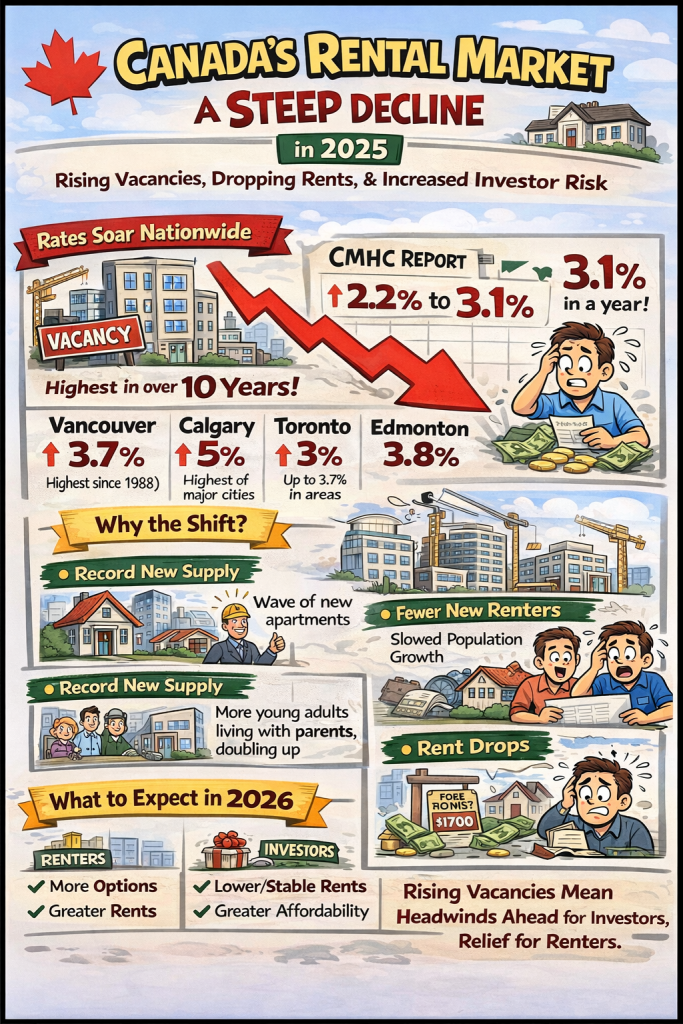
Across Canada in 2025, many real estate investors are confronting an unexpected challenge: projects that once assumed tight rental conditions are now facing rising vacancies and softer rents. For some owners who invested millions of dollars into new rental or purpose-built housing projects, units are taking longer to lease, incentives are growing, and financial assumptions are being tested.
According to CMHC’s 2025 Rental Market Report, Canada’s purpose-built rental vacancy rate rose from 2.2% to 3.1% in one year, up from below 2% in 2023. This marks the highest national vacancy rate in over a decade, and in certain cities, vacancies have reached levels not seen in generations.
Vacancy Rates Reach Historic Levels in Major Cities
The increase is broad-based, affecting nearly every major urban market:
- Vancouver: Vacancy climbed to 3.7%, the highest level since 1988
- Toronto: Purpose-built vacancy reached 3%, rising to 3.7% in some submarkets
- Calgary: Vacancy around 5%, the highest among major cities
- Edmonton: Approximately 3.8%
- Ottawa and Halifax: Traditionally tight markets also saw noticeable increases
Nationally, vacancy rates are now above the 10-year average, signaling a structural shift rather than a short-term anomaly.
Why Is This Happening?
The rise in vacancies reflects a simultaneous increase in supply and weakening of demand.
1. Record New Supply
Canada experienced historically high rental construction completions in 2024–2025. Thousands of new apartments—many of them purpose-built rentals—have come online or are nearing completion. Government incentives, CMHC financing programs, zoning changes, and tax measures helped keep projects moving even in a higher interest-rate environment.
However, much of this new supply is newer, higher-priced housing, which tends to face slower absorption during periods of softer demand.
2. Slowing Population Growth
At the same time, population growth slowed sharply in 2025 and turned negative in some markets. Declines were particularly pronounced in Ontario and British Columbia, where reduced international student numbers and slower immigration had an outsized impact on rental demand.
CMHC also noted a decline in the 15–34 age cohort in several markets—a group that historically drives renter household formation.
3. Weaker Household Formation
With youth unemployment elevated compared to pre-2022 levels and affordability still stretched, many young adults are delaying moving out, living with parents longer, or doubling up with roommates. Fewer new households are forming, even as thousands of new units are being delivered.
The basic equation is straightforward:
More supply + less demand = rising vacancies
How Landlords Are Responding
As vacancy rates increase, landlords—particularly owners of newer and higher-end buildings—are becoming more aggressive in order to fill units.
Common incentives now include:
- One to three months of free rent
- Moving allowances
- Free parking, internet, or storage
- Signing bonuses
In many cases, these incentives are structured to preserve net operating income (NOI), especially for projects financed through CMHC MLI Select programs. For example, offering three months free rent is economically similar to an 8–9% annual rent discount, while keeping the face rent unchanged for valuation purposes.
Despite this, rent growth for new leases has slowed or reversed in several cities. In Toronto, Vancouver, Calgary, and Halifax, new tenants are often paying less than the previous tenant paid a year earlier.
A Market Split by Price Segment
CMHC data shows that vacancies have increased across all rent levels—but not equally.
- Lower-rent units remain in short supply, often with vacancies below 1%
- Mid- and high-end units show significantly higher vacancies and slower absorption
In Calgary, for example, vacancy in the top quartile of new luxury projects exceeded 6%, far above the rate for more affordable units. This has narrowed the rent gap between older, depreciated stock and newer buildings.
The Risk Investors May Be Underestimating
Many rental investment models anticipated some increase in vacancy, but few stress-tested scenarios above 3–4%. In reality, several major markets are already approaching or exceeding 5% vacancy, and rents for new leases are falling in real terms.
For highly leveraged projects—especially those using 90–95% loan-to-value CMHC financing with long amortizations—the dominant risk is interest rates, not just vacancy. These projects behave less like traditional real estate investments and more like long-duration bond trades, highly sensitive to bond yields.
When rising vacancies and flat or declining rents combine with elevated financing costs, margins compress quickly.
The Role of “Shadow Demand”
Some analysts argue that rising vacancies will be short-lived due to pent-up or “shadow” demand—young adults living at home longer than they prefer, renters doubling up, or households stuck in suboptimal housing.
This demand is real, but it differs fundamentally from immigration-driven demand:
- It is income-constrained
- Highly price-sensitive
- Absorbs supply gradually, not suddenly
Shadow demand can place a floor under rents eventually, but that floor may be lower than many landlords expect, especially if wages and youth employment take time to recover.
What This Means for 2026
The Bull Case
- Higher vacancies reduce rent pressure
- More choice gives renters negotiating power
- Slower rent growth frees household income for other spending
- CMHC expects affordability to improve gradually if incomes rise and vacancies remain elevated
The Bear Case
- Landlords face sustained pressure from incentives, vacancy, and financing costs
- Highly leveraged projects may underperform or become cash-flow negative
- Pre-construction and speculative rental deals face increased risk
- A recession or renewed rate increases could amplify stress
At the same time, rising vacancies could mislead policymakers into complacency, slowing progress on truly affordable housing—particularly larger, family-sized units, which remain in extremely short supply.
Key Takeaway
Canada’s rental market in 2025 is undergoing a meaningful rebalancing. After years of extreme tightness, vacancies are rising, rents for new tenants are softening, and risk is shifting back onto investors and landlords. While this may improve conditions for some renters in 2026, it also exposes how dependent recent rental growth was on rapid population inflows and ultra-tight supply.
Whether the market stabilizes or deteriorates further will depend on employment trends, interest rates, population policy, and how quickly shadow demand can absorb the new supply.
 Pre-Construction 24 7