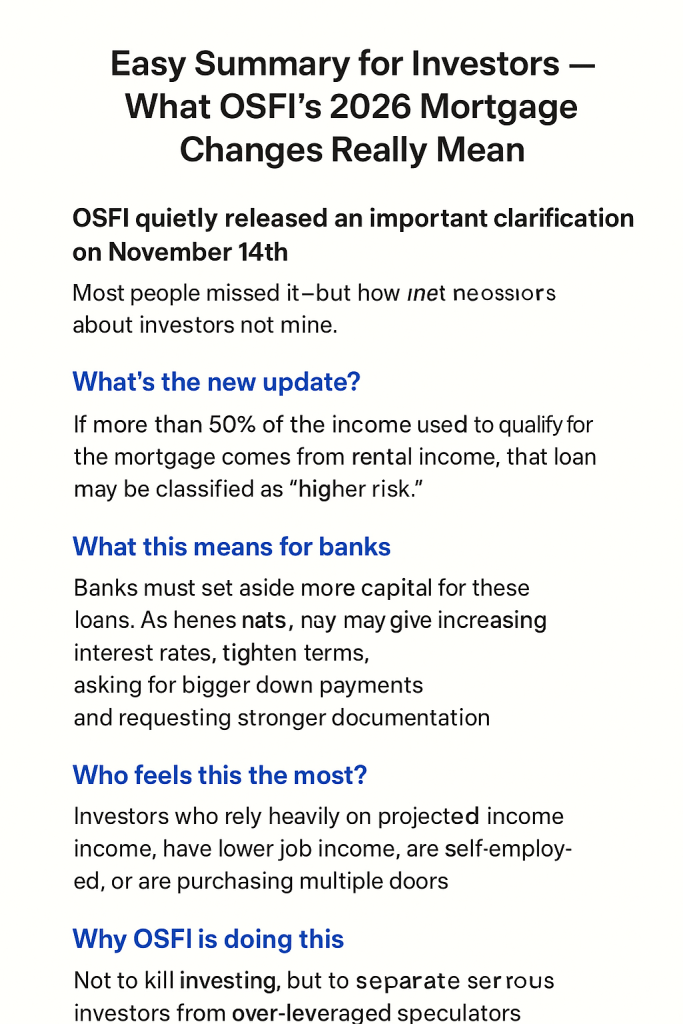
Canada’s bank regulator, OSFI, quietly released an important clarification on November 14th that most people missed— but investors shouldn’t.
Back in September, OSFI introduced a new risk category called Income-Producing Residential Real Estate (IPRRE). This applies to mortgages that rely heavily on rental income to qualify. Think investment condos, duplexes, or any property where, if the tenant leaves, the borrower might struggle to cover the mortgage.
What’s the new update?
OSFI has clarified how banks decide if a mortgage falls into this high-risk category:
➡️ If more than 50% of the income used to qualify for the mortgage comes from the property’s rental income, that loan may be classified as “higher risk.”
This rule kicks in 2026, but banks will start preparing early.
What this means for banks
If a mortgage is considered higher risk, banks must set aside more capital to support that loan. And when a loan becomes more expensive for banks, they adjust by:
- Increasing interest rates
- Tightening terms
- Asking for bigger down payments
- Requesting stronger documentation
Banks aren’t changing how you qualify — your stress test, down payment, and paperwork stay the same.
What changes is the bank’s internal cost of carrying your mortgage.
Who feels this the most?
Mainly investors who:
- Rely heavily on projected rental income
- Have lower job income
- Are self-employed
- Are purchasing multiple doors
End-users (homeowners) are less affected because they typically qualify using employment income.
Why OSFI is doing this
This isn’t meant to kill investing.
It’s meant to separate serious investors from over-leveraged speculators.
During 2021–2022, some projects had 70% investor sales, and when the market shifted, many couldn’t close — hurting builders and end-users. OSFI wants to make the system safer and more sustainable.
What this means for the market
Over the next 12–18 months:
For homebuyers (end-users):
- Less investor competition
- More stable pricing
- Banks more eager to lend to you
For sellers:
- Shift focus toward end-users
- Investors will still buy — but mainly the strong ones with strong cash flow
For investors:
This is the big one.
- Cash flow matters more than ever
- You may need more equity to qualify
- Expect slightly higher rates on rental-heavy deals
- Be prepared to justify your numbers
- Strong tenants + solid income = huge advantage
This won’t crash the market — but it will cool investor demand in high-priced areas like the GTA, where cap rates are already razor thin.
The bottom line
This update is a structural shift in how banks price risk.
It will reshape the investor landscape, bring more balance to the market, and give end-users a better shot at buying.
If you’re planning a purchase, refinance, pre-construction closing, or investment, now’s the time to review your numbers and speak with your mortgage advisor.
 Pre-Construction 24 7