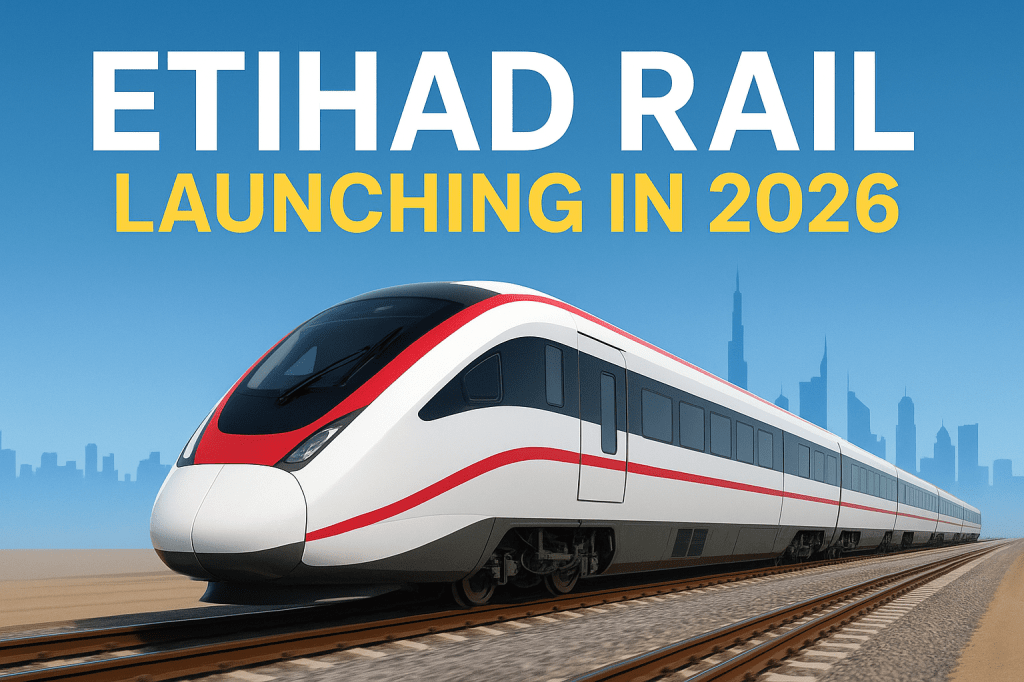
For decades, the UAE built some of the world’s most advanced airports, ports, and highways. But until now, it lacked one thing most countries have had for generations: a national passenger railway. That gap closes in 2026, when the UAE launches its first-ever passenger services under Etihad Rail. The newly revealed trains at the Global Rail 2025 Exhibition in Abu Dhabi mark a turning point—a moment when the country expands from a car-first culture into a fully integrated, sustainable, national mobility system.
Why Etihad Rail Matters
Despite impressive road networks, congestion costs the UAE more than $7 billion annually, with nearly every household owning at least one car. Transport emissions remain high, challenging the country’s goal of reaching Net Zero by 2050. Etihad Rail is not just a transportation project—it is a national strategy to cut congestion, reduce emissions, modernize mobility, and support a population expected to reach 15 million by 2030.
A Mega Network Connecting the Entire UAE
The full Etihad Rail network spans 1,200+ kilometers, linking all seven emirates and eleven major cities. The passenger-focused portion covers 900 kilometers and is designed to carry 36.5 million passengers annually. This long-term plan positions the UAE alongside countries with mature rail networks, giving residents and investors a new way to move, commute, and relocate.
Key Routes and Game-Changing Travel Times
One of the greatest benefits is time savings. Major journeys shrink dramatically:
- Abu Dhabi → Dubai: 50 minutes
- Dubai → Fujairah: 50 minutes
- Abu Dhabi → Ruwais: Just over 1 hour
- Abu Dhabi → Fujairah: 1 hour 40 minutes
Future upgrades include a 350 km/h high-speed line that could cut Abu Dhabi–Dubai travel to just 30 minutes. Cross-border expansion to Oman will connect Abu Dhabi to Sohar in 1 hour 40 minutes and Al Ain to Sohar in 47 minutes, strengthening the region’s economic competitiveness.
Stations Built for a Connected Lifestyle
The first stations are planned at Sakamkam (Fujairah) and University City (Sharjah), with more coming across the UAE—including connections near Jumeirah Golf Estates and Al Maktoum International Airport. Integration with Dubai’s RTA will ensure seamless access via metro, buses, and taxis. For the first time, the UAE will have a national mobility grid connecting rail with urban transport.
Train Technology & Passenger Experience
Etihad Rail’s trains run at 200 km/h, matching European intercity standards, with future versions reaching 350 km/h. Each train carries 400+ passengers across three classes: Economy, Family, and First Class. The Business cabin mirrors an aircraft experience, while spacious Economy layouts prioritize comfort.
Onboard features include infotainment screens, power outlets, Wi-Fi, F&B services, and desert-grade climate systems. Stations feature retail, lounges, and luxury interiors crafted by Italy’s Arsenale—the team behind Orient Express–inspired concepts.
Engineering Built for the Desert
Building a railway in the Gulf required solutions for extreme heat, shifting sands, and unstable Sabkha soil. Engineers designed sealed cooling systems, elevated track sections, tunnels, causeways, and 145+ bridges and overpasses. This is not imported engineering—it is rail infrastructure reinvented for desert conditions.
Freight Operations Already Transforming Logistics
Etihad Rail began as a freight network, moving over 3 million tons of cargo since 2016 using 38 locomotives and more than 1,000 wagons. One freight train replaces around 300 trucks, easing pressure on highways and reducing emissions. Passenger services will share this powerful backbone, creating a dual-purpose national system.
Part of a Much Bigger Vision: GCC Rail
Etihad Rail connects into the upcoming 2,200 km GCC Railway, linking the UAE with Saudi Arabia, Oman, Kuwait, Qatar, and Bahrain. This alignment ties the Gulf to global trade corridors, ports like Jebel Ali and Khalifa Port, and potentially China’s Belt & Road Initiative. The UAE becomes a central gateway for regional commerce and tourism.
Economic & Environmental Impact
The rail network is expected to generate $13 billion for the UAE’s GDP, create 9,000 direct jobs and 30,000 indirect jobs, and reduce travel times across the country by up to 40%—helping people live in one emirate and work in another with far more ease. Trains emit 75% less CO₂ per passenger compared to cars and support the UAE’s national emissions reduction target of 21% by 2050. Future renewable energy integration (including the 5,000 MW Mohammed bin Rashid Solar Park) will further reduce environmental impact.
Will People Shift from Cars to Trains?
The UAE’s deep car culture will not change overnight. But faster travel times, lower costs, reduced stress, and premium onboard experiences could push many commuters—and logistics companies—to adopt rail. Tourism will change too, connecting mountains, cities, coasts, and attractions through a single national line. The next few years will reveal how profoundly this shift reshapes daily life.
Final Thought
Etihad Rail is more than a transport project—it is a defining piece of the UAE’s future. For investors, it unlocks new real estate corridors and economic zones. For residents, it promises shorter commutes, cleaner air, and new lifestyle possibilities. For the region, it positions the UAE as a mobility and logistics powerhouse.
It is a new chapter in how the UAE grows, connects, and redefines progress.
 Pre-Construction 24 7