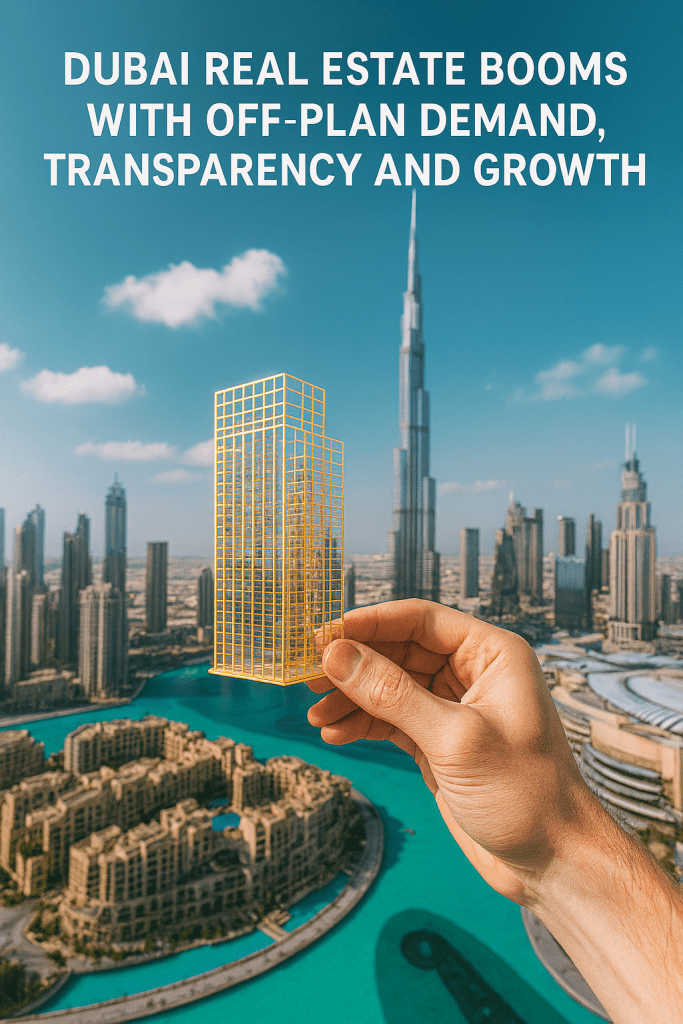
Dubai’s real estate market continues to soar to record highs, driven mainly by off-plan sales, which now make up three out of every four transactions. Developers have perfected marketing, payment plans are flexible, and international buyers are attracted by Dubai’s global brand, lifestyle, and fear of missing out on strong capital appreciation. Many investors buying off-plan have never even visited Dubai, relying heavily on marketing visuals, transparent data, and trusted transaction records from the Dubai Land Department, which allow them to calculate returns without relying solely on agents.
A major investor advantage is that Dubai offers full market transparency—buyers can look up recent sales, rental prices, and yields instantly. Combine this with slick marketing, easy entry payment plans, and strong expected appreciation, and off-plan continues to dominate.
While off-plan is booming, the ready property market has seen slower activity mainly due to limited stock, not lack of demand. Fewer people are leaving Dubai, and end users can’t easily “trade up” because many villa and townhouse communities are still under construction. Agents say they face intense competition and scarcity: unlike in 2019 when ready units sat unsold with incentives, today units often sell within minutes of launch.
Prices continue rising fast — around 16% year-on-year, with almost all villa and townhouse communities posting double-digit growth. Apartment areas such as JVC, Dubai Marina, and Sports City are also seeing strong appreciation. More mature high-density areas like Business Bay and Downtown show slower, single-digit growth but remain in demand because of their central locations and constant development cycles.
Ultra-luxury sales remain a world of their own, driven by global high-net-worth individuals choosing Dubai as a wealth hub. The city now rivals top international markets and often outperforms them. Lifestyle, tax benefits, and global uncertainty elsewhere continue to pull wealthy buyers into the UAE.
Developers are speeding up construction cycles from over 1,300 days to under 900 days thanks to modular building, prefabricated components, and some developers launching their own construction divisions. But smaller developers still struggle, and supply-chain issues—especially with Saudi Arabia also building at scale—keep causing delays. Only about 9,400 units were delivered in Q3 instead of the projected 22,800, contributing to the housing shortage and keeping rents high.
Rental growth has slowed to around 11%, partly due to more supply and partly because the Smart Rental Index now regulates increases more precisely by building. This adds fairness and stability for both tenants and landlords.
Mortgage transactions are rising too, up 12%, because more units are being handed over and banks are expanding financing options—even offering loans on properties that are 50% complete or 50% paid. With an enormous wave of off-plan units expected in the next few years, banks are preparing to grow their mortgage portfolios.
Looking ahead, the biggest test for the market will be the huge pipeline of units scheduled for 2026–2027. While the official projections suggest massive supply, many believe completions will stretch into 2029–2030 because delivering such volumes is physically difficult. Still, Dubai’s population is expected to grow from 4 million to 5 million in the next four to five years, meaning demand may remain strong enough to absorb new supply.
Overall, the market is in a rare phase: 63 straight months of price growth, massive global investor appetite, strong rental yields, and an unprecedented pace of development. The fundamentals—population growth, transparency, global appeal, and lifestyle advantages—remain the key reasons investors continue to pour into Dubai real estate.
 Pre-Construction 24 7