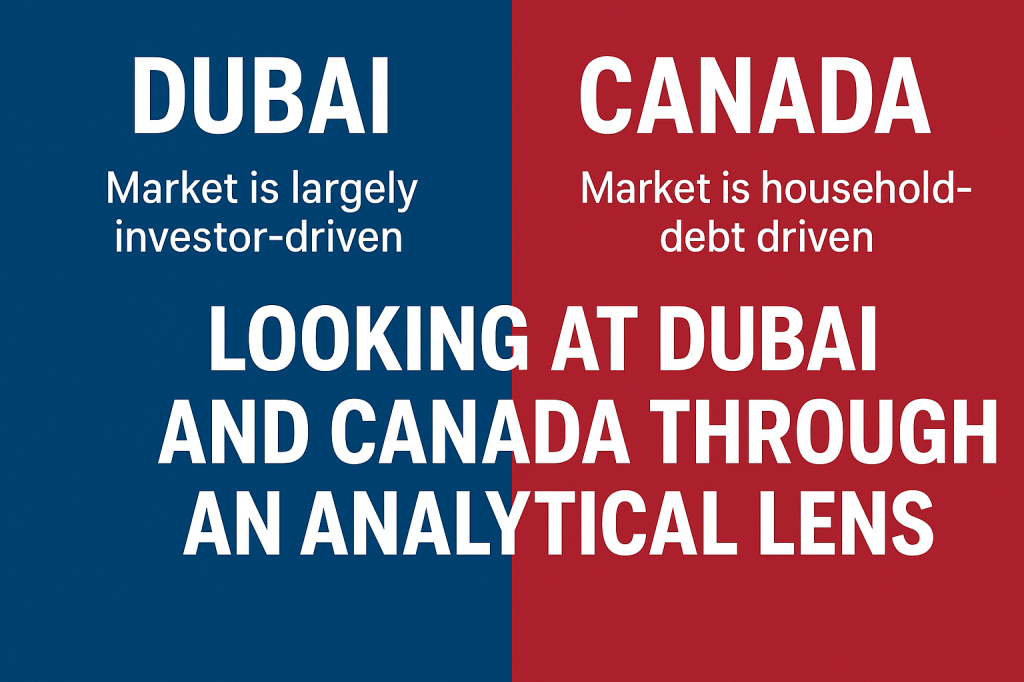
Looking at Dubai and Canada through an analytical lens, the dynamics are quite different, because Canada’s market is household-debt driven while Dubai’s is largely investor-driven!
1. Real Estate’s Share of GDP:
- In Canada, housing consumes ~8% of GDP, double the U.S. level (~4%).
- In Dubai/UAE, real estate accounts for roughly 7–8% of GDP, similar to Canada, but it’s far more diversified within investment flows: tourism, logistics, financial services, and trade also contribute significantly. Dubai is not as “household debt-driven” as Canada because a large portion of the real estate market is investor-driven rather than owner-occupier-driven. Many purchases are for rental income or capital gains, often paid in cash or via smaller mortgages.
2. Household Debt Exposure:
- Canadian households are highly leveraged, so rising interest rates hit consumption directly.
- In Dubai, household leverage is relatively lower. Mortgages exist, but a significant share of buyers are expatriates or foreign investors, so domestic consumption isn’t as tightly tied to mortgage payments, reducing systemic risk from rate changes.
3. Market Resilience:
- Canada’s market faces stress from affordability ceilings and rising mortgage delinquencies.
- Dubai’s market is more speculative but flexible, with a history of quick rebounds after corrections. Strong foreign demand, low taxation, and visa incentives (e.g., Golden Visa tied to property investment) maintain liquidity. Oversupply is a risk in certain segments, but prices are often supported by investor appetite rather than just household affordability.
4. Macro-Economic Implications:
- In Canada, housing acts as a brake on GDP when interest rates rise.
- In Dubai, real estate volatility affects investment inflows and rental yields more than domestic consumption. GDP growth is supported by oil diversification policies, tourism, and finance, cushioning the broader economy from real estate swings.
5. Investment Takeaways:
- Canada: Rising mortgage debt + affordability stress = systemic economic risk.
- Dubai: Real estate is a key GDP driver but less tied to household debt; investors can capitalize on growth cycles without as much risk to local consumer demand. Strategic timing, location, and segment (luxury vs. mid-market) matter more than macro interest rate fears.
In short: Dubai’s real estate market is less of an economic risk factor and more of an investment and diversification engine, unlike Canada where housing stress can cascade into GDP slowdown. Investors should focus on market cycles, supply-demand balance, and government incentives, not domestic consumption pressures.
 Pre-Construction 24 7