Dubai’s new first-time homebuyer program is a clear signal that the government is engineering long-term end-user demand, making early-entry off-plan investments in family-focused Tier 1 communities more valuable and strategically safer for investors.
Dubai’s New First-Time Homebuyer Program — Key Points Investors Must Know
Dubai has launched a new government-backed First-Time Homebuyer Program for UAE residents aged 18+ who’ve never owned a freehold property and are buying homes up to $1.36M USD. The program gives genuine first-time buyers priority access, special pricing, and pre-launch entry to projects from top developers—prices normally reserved for insiders and seed investors. Banks are also offering tailored 25-year mortgage plans where payments adjust to rising income, making ownership easier for young families.
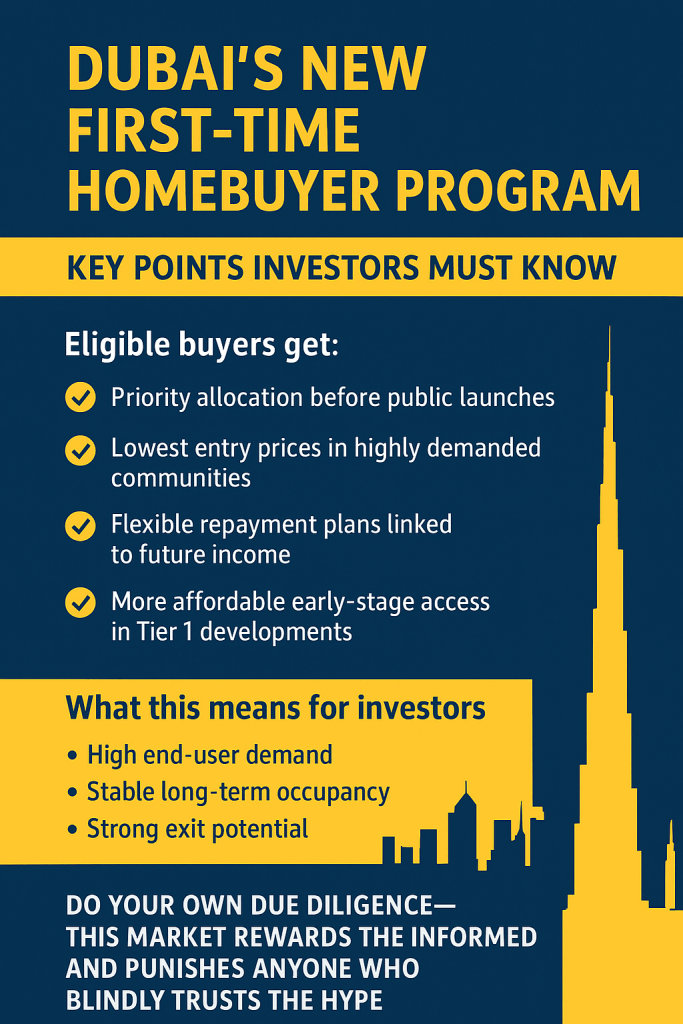
Eligible buyers get:
- Priority allocation before public launches
- Lowest entry prices in highly demanded communities
- Flexible repayment plans linked to future income
- More affordable early-stage access in Tier 1 developments
But first-time buyers must plan carefully: budget the 20–25% down payment, consider that mortgages are often variable-rate, and account for 7% extra costs (4% DLD fee, 2% agency fee, 1% mortgage/admin fees). And most importantly—ensure mortgage payments stay below one-third of household income to protect lifestyle and financial stability.
What this means for investors
This program signals massive demand growth in family-oriented communities as Dubai targets 7–8 million residents by 2030. As thousands of new residents transition from renting to owning, the areas supported by this program will see:
- High end-user demand
- Stable long-term occupancy
- Strong exit potential
For investors, the strategy is clear:
- Buy at the lowest entry point (off-plan, pre-launch, Tier 1).
- Choose areas where families will settle, not where oversupply is rising.
- Prioritize exit strategy—strong resale demand from end users is far more important than short-term rental yield.
Dubai is aligning infrastructure (airport expansion, Blue Line metro, tech growth) with population growth—and this new program shows exactly where real, end-user demand will be strongest.
 Pre-Construction 24 7