Canada’s Housing Market
Despite eight interest-rate cuts, affordability has not returned—it’s a myth pushed by headlines, not supported by real data. Prices have dropped on paper, but after adjusting for inflation, the real declines are far deeper: Hamilton is down nearly 40%, the GTA about 34%, yet most Canadians still cannot qualify for a mortgage because home costs require 85–100% of median household income in cities like Toronto and Vancouver. Under Canada’s lending rules, buyers can only spend 40% of income on housing (GDS), which instantly blocks the majority of people from ownership.
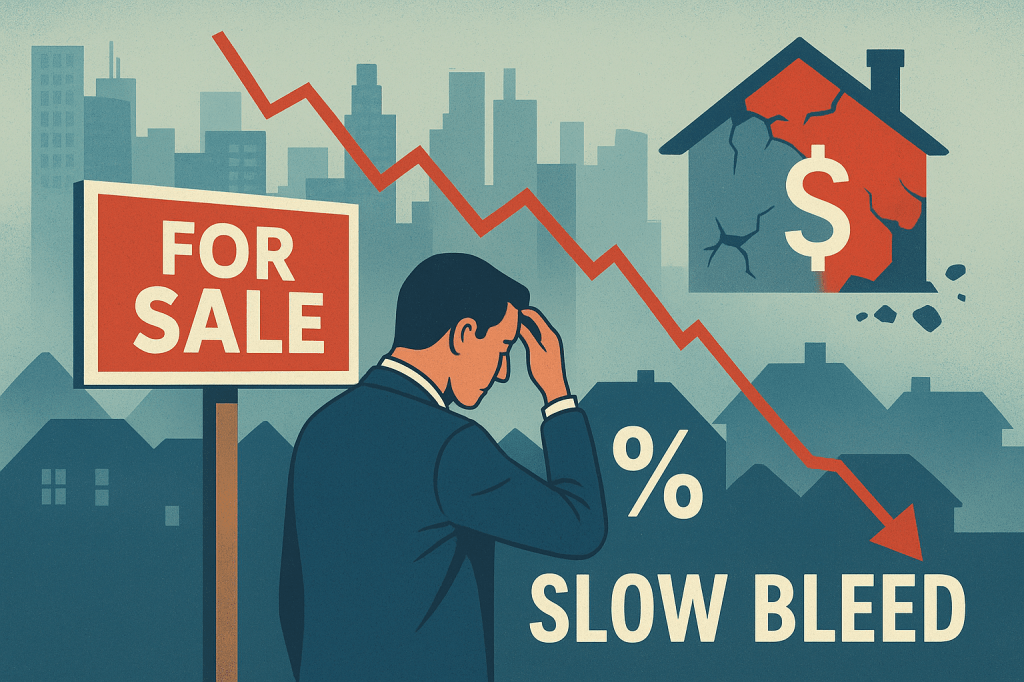
At the same time, thousands of condos remain unsold, including 2,500 empty new units in Metro Vancouver, almost double the year before. Even with rate cuts, the market has barely moved—sales are flat, listings keep piling up, and Toronto is on track for one of its lowest sales years in 30+ years. This isn’t a crash; it’s a slow bleed, where prices drip down gradually while the market stays stuck in limbo.
Regional gaps are becoming extreme. Calgary and much of Alberta remain affordable and stable, attracting migration, while Ontario and BC are struggling with high prices, low sales, and investor pullback. Quebec is cooling more gently. In the GTA and Hamilton, the situation is worse—condo construction has slowed to a crawl, development fees have jumped over 40%, and entry-level housing is vanishing. This sets up a serious supply shortage in 5–7 years, making today’s affordability problems even worse.
Delinquency rates are rising—from near zero to 0.21% (about 1 in 476 mortgages). While this is far below 2008 levels, the real risk is in private and fringe lenders who are already forcing power-of-sale situations, often accepting lower prices just to recover capital. These distressed sales quietly push neighborhood values down.
The broader economic impact is massive. Canada invests 8% of its GDP into residential real estate—double the US. This means the country is over-exposed: when the housing market weakens, the entire economy slows because Canadians spend more income on debt than on goods, services, or business growth. Real estate doesn’t just influence wealth—it dictates it, tightening financial pressure on households and the national economy.
Politicians may point to falling nominal prices and rate cuts as proof of a “recovery,” but the numbers tell a different story. Affordability has barely improved, sales are historically low, and supply issues are building beneath the surface. Canada’s housing market isn’t crashing—it’s quietly sick, fragile, and heading toward long-term structural problems.
For investors, this means one thing:
The market is not recovering—it’s stalling. And the next 5–7 years will be defined by slow bleeding prices, rising economic strain, and an eventual supply crunch in major cities.
 Pre-Construction 24 7